BioFresh System Repair
Targeted diagnosis for biofresh system repair covering compartment temperatures, airflow, sensors, and IceMaker behavior common in Bay Area installations.

Specialized Liebherr Appliance Repair in San Francisco
Mon–Sat: 8:00 AM – 7:00 PM
Built-In Refrigeration vary by layout and controls. This page covers the main configurations seen in San Francisco homes and the symptoms that usually point to airflow, sensing, or door conditions.
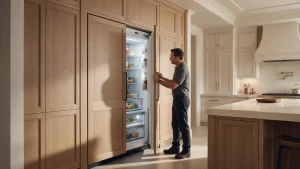
Built-in and integrated Liebherr cabinets are made to disappear behind cabinetry. They come as full refrigerators, fridge-freezers, freezers, and wine cabinets, and most are designed either for a fixed-hinge door fitted with a matching panel or for a sliding-hinge arrangement. This page explains how they are put together and why installation matters so much.
The appliance door carries a decorative panel supplied with the kitchen. The weight of that panel changes how the door hangs, and it is attached through a system that lets the installer adjust the gap to the neighboring cabinet. If that adjustment drifts, the door can rub or fail to seal.
Heat produced by the compressor has to leave the niche. Integrated models therefore specify openings at the plinth and at the top, and they expect those openings to remain clear. Anything that narrows the opening raises the working temperature of the cooling system, which can show up as a cabinet that runs constantly and never quite reaches the set value.
A door that does not stay closed, an alarm after normal use, a cabinet that is warm during the evening, or condensation along the panel’s edge are the typical complaints. Most can be traced to alignment or airflow before any cooling component is considered.
On integrated cabinets the rating plate may only be visible with the door open fully, and some are placed on the side wall of the interior behind a shelf. Take a clear photo of the label and the service number so it is available without moving the panel later.
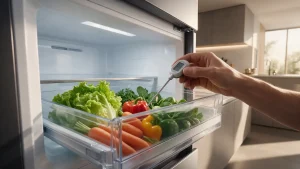
Look at the visible vent, feel for warm air when the unit runs, and verify that the door swings freely without catching on a neighbor. Read the internal temperature with a separate thermometer. Do not unscrew the panel, the plinth, or any hinge cover.
For the service steps on this layout see the built-in refrigeration service page. Models such as the HCB and ICBN families, which appear in the model section, are examples of integrated cabinets handled in the Bay Area.
Many integrated cabinets here were installed into joinery designed for an earlier appliance. That joinery may offer less ventilation than the manufacturer’s installation guide specifies, which explains why an otherwise healthy unit sometimes struggles in summer. Knowing how the niche was built helps with diagnosis.
Because the door is part of the cabinetry, avoid hanging towels or heavy items from the panel, which stresses the hinges. Wipe the gasket regularly, keep the ventilation opening free of dust, and avoid storing items on top of the cabinet where they might narrow the vent.
If a kitchen has been remodeled around an existing cabinet, it is worth confirming that the niche still provides the clearances and ventilation specified for that model. Mention any remodel when you describe a problem, because modifications to the cabinetry are a frequent hidden cause.
Helpful information includes the time of day the problem is worst, whether the door has been adjusted recently, how the cabinet is vented, and what stands next to it. Add the model photographed from the interior label and a picture of the whole door and panel from the front.
Mention any previous attempts to adjust the hinges, because uneven adjustment can leave the door out of true in a way that is not obvious.
Usually on the rating plate inside the fresh-food compartment or on the door frame. On built-in units open the door fully.
No. Short codes can have different meanings by platform and generation.
BioFresh is a temperature-controlled zone with its own behavior. Problems there are diagnosed separately from the main cabinet.
Targeted diagnosis for biofresh system repair covering compartment temperatures, airflow, sensors, and IceMaker behavior common in Bay Area installations.
Targeted diagnosis for bottom-freezer refrigerator repair covering compartment temperatures, airflow, sensors, and IceMaker behavior common in Bay Area installations.
Targeted diagnosis for built-in refrigeration repair covering compartment temperatures, airflow, sensors, and IceMaker behavior common in Bay Area installations.
Targeted diagnosis for monolith refrigeration repair covering compartment temperatures, airflow, sensors, and IceMaker behavior common in Bay Area installations.
Targeted diagnosis for refrigerator repair covering compartment temperatures, airflow, sensors, and IceMaker behavior common in Bay Area installations.
AFr points to a condition described in Liebherr documentation for specific platforms. Measured temperatures clarify the impact.
BT001 points to a condition described in Liebherr documentation for specific platforms. Measured temperatures clarify the impact.
btE points to a condition described in Liebherr documentation for specific platforms. Measured temperatures clarify the impact.
btP points to a condition described in Liebherr documentation for specific platforms. Measured temperatures clarify the impact.
dOr points to a condition described in Liebherr documentation for specific platforms. Measured temperatures clarify the impact.
E0 points to a condition described in Liebherr documentation for specific platforms. Measured temperatures clarify the impact.
Diagnostic notes for the CBN 5413 focusing on compartment behavior and model-specific checks.
Diagnostic notes for the CBNes 5168 focusing on compartment behavior and model-specific checks.
Diagnostic notes for the CS 2062 focusing on compartment behavior and model-specific checks.
Diagnostic notes for the HC 1540 focusing on compartment behavior and model-specific checks.
Diagnostic notes for the HC 1541 focusing on compartment behavior and model-specific checks.
Diagnostic notes for the HCB 1560 focusing on compartment behavior and model-specific checks.
Diagnostic notes for the HCB 2080 focusing on compartment behavior and model-specific checks.
Diagnostic notes for the ICBN 3366 focusing on compartment behavior and model-specific checks.
Diagnostic notes for the ICBN 3386 focusing on compartment behavior and model-specific checks.
Diagnostic notes for the Monolith MRB 3600 focusing on compartment behavior and model-specific checks.
Diagnostic notes for the SBS 246 focusing on compartment behavior and model-specific checks.
Diagnostic notes for the SBSes 7155 focusing on compartment behavior and model-specific checks.
Reference for biofresh refrigeration covering subtypes, typical symptoms, and where to find the model number in San Francisco installations.
Reference for bottom-freezer refrigerators covering subtypes, typical symptoms, and where to find the model number in San Francisco installations.
Reference for icemakers covering subtypes, typical symptoms, and where to find the model number in San Francisco installations.
Reference for Liebherr freezers covering subtypes, typical symptoms, and where to find the model number in San Francisco installations.
Reference for Liebherr refrigerators covering subtypes, typical symptoms, and where to find the model number in San Francisco installations.
Reference for monolith refrigeration covering subtypes, typical symptoms, and where to find the model number in San Francisco installations.
Reference for nofrost refrigeration covering subtypes, typical symptoms, and where to find the model number in San Francisco installations.
Reference for wine cabinets covering subtypes, typical symptoms, and where to find the model number in San Francisco installations.
Share a few details and we’ll confirm an appointment. Prefer to talk? Call us and we’ll help right away.