IceMaker Repair
Targeted diagnosis for icemaker repair covering compartment temperatures, airflow, sensors, and IceMaker behavior common in Bay Area installations.

Specialized Liebherr Appliance Repair in San Francisco
Mon–Sat: 8:00 AM – 7:00 PM
IceMakers vary by layout and controls. This page covers the main configurations seen in San Francisco homes and the symptoms that usually point to airflow, sensing, or door conditions.
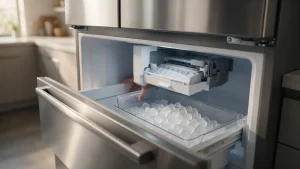
Liebherr IceMakers are either built-in modules or integrated systems fed from the household water supply, and they produce ice automatically in a mold and store it in a bin. This reference describes how they work, which parts are involved, and what symptoms suggest where a fault lies.
Water enters through an inlet, passes a filter in some designs, and fills a small mold. The cold in the freezer turns the water to ice, and a mechanism then releases the cubes into the bin. A sensor stops the cycle when the bin is full. A fault at any point changes the result in a recognizable way.
Some IceMakers are connected permanently to a water line, while others rely on a tank that must be filled. Check which type you have before troubleshooting. Plumbed units depend on the shutoff valve and line behind the cabinet, while tank-fed units depend on the tank being full and seated correctly.
An empty bin points to supply or freezing problems. Hollow cubes point to a weak fill. Cubes fused in the bin suggest temperature fluctuation or old ice. Water beneath the unit suggests a leak at a connection or ice melting and refreezing. Each result narrows the search to one stage of the cycle.
On integrated systems the label is usually in the freezer cavity or beside the module, and on tank-fed models it is often on the housing. Record the model and service number. If the IceMaker is a module in a larger cabinet, there may be two labels, so photograph both.
Verify the water shutoff, look for a kinked line, check the bin position, and measure the freezer temperature. Replace the filter on schedule, and do not pour hot water into the module or force ice out with tools.
See the IceMaker service page for the visit steps. The error-code pages cover tokens related to ice production on supported platforms.
In older San Francisco buildings, supply lines can be hard to reach and shutoff valves stiff. A line crushed when the cabinet was pushed back into place is among the commonest hidden causes of a slow fill, so mention any recent installation or move.
Use the ice regularly, since ice that sits for weeks takes on freezer odors and may clump. Keep the bin clean and dry, replace the filter on the recommended schedule, and avoid storing strongly scented food next to the module in an open container.
After installation or after the water has been turned off for any reason, discard the first few batches of ice, since they may contain air or residue from the lines. If the unit is to be left unused for a long time, empty the bin and follow the instructions for turning off the water supply.
Say whether the bin is empty or the ice is wrong in some way, how long it has been like this, and whether water dispensing is affected as well. Mention the last filter change and whether the cabinet was moved lately. Add the freezer temperature, since it influences nearly every IceMaker symptom.
It takes a while for a fresh batch of ice to form, and output varies with freezer temperature and how often the bin is emptied. A bin that fills slowly after heavy use is not a fault. Missing ice for a full day, or cubes that are consistently misshapen, is the point at which a closer look is justified.
Usually on the rating plate inside the fresh-food compartment or on the door frame. On built-in units open the door fully.
No. Short codes can have different meanings by platform and generation.
BioFresh is a temperature-controlled zone with its own behavior. Problems there are diagnosed separately from the main cabinet.
Targeted diagnosis for icemaker repair covering compartment temperatures, airflow, sensors, and IceMaker behavior common in Bay Area installations.
FE points to a condition described in Liebherr documentation for specific platforms. Measured temperatures clarify the impact.
MA001 points to a condition described in Liebherr documentation for specific platforms. Measured temperatures clarify the impact.
WATER points to a condition described in Liebherr documentation for specific platforms. Measured temperatures clarify the impact.
Reference for biofresh refrigeration covering subtypes, typical symptoms, and where to find the model number in San Francisco installations.
Reference for bottom-freezer refrigerators covering subtypes, typical symptoms, and where to find the model number in San Francisco installations.
Reference for built-in refrigeration covering subtypes, typical symptoms, and where to find the model number in San Francisco installations.
Reference for Liebherr freezers covering subtypes, typical symptoms, and where to find the model number in San Francisco installations.
Reference for Liebherr refrigerators covering subtypes, typical symptoms, and where to find the model number in San Francisco installations.
Reference for monolith refrigeration covering subtypes, typical symptoms, and where to find the model number in San Francisco installations.
Reference for nofrost refrigeration covering subtypes, typical symptoms, and where to find the model number in San Francisco installations.
Reference for wine cabinets covering subtypes, typical symptoms, and where to find the model number in San Francisco installations.
Share a few details and we’ll confirm an appointment. Prefer to talk? Call us and we’ll help right away.