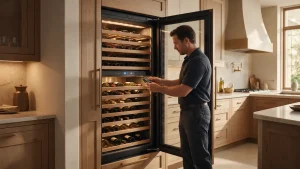
Wine Cabinet Repair
Targeted diagnosis for wine cabinet repair covering compartment temperatures, airflow, sensors, and IceMaker behavior common in Bay Area installations.

Specialized Liebherr Appliance Repair in San Francisco
Mon–Sat: 8:00 AM – 7:00 PM
Wine Cabinets vary by layout and controls. This page covers the main configurations seen in San Francisco homes and the symptoms that usually point to airflow, sensing, or door conditions.
Liebherr wine cabinets are built to store wine at stable temperatures, with careful attention to vibration and to the difference between serving and ageing conditions. They are offered as freestanding cabinets, built-in units, and columns, with one, two, or three temperature zones depending on the model.
In a multi-zone cabinet, each zone has its own sensor and control. That lets the same cabinet hold sparkling and white wines at a cooler setting and red wines at a warmer one. A reading that departs from the set point in one zone does not automatically mean the other zone is affected.
Constant movement can disturb the sediment in wine and disrupt ageing, so these cabinets use quiet compressors and mounting designed to limit vibration. Noise from a cabinet therefore often comes from the surroundings, such as a shelf touching a bottle or a cabinet resting on an uneven floor.
Drift in one zone, a warm cabinet in the afternoon, condensation on the glass, and alarms after a door opening are the usual reports. Because wine reacts to long exposure rather than to short spikes, a trend of readings over several days matters more than one measurement.
The plate is often at the side or the back of the interior, or at the edge of the door frame. Record the model and service number, since zone count and control type depend on them.
Keep the ventilation space clear, avoid direct sun, make sure the door seals, level the feet, and take a reading at bottle height in each zone. Do not rearrange the interior in ways the manual does not describe, and keep the panels closed.
The wine cabinet service page explains the visit. The model section includes cabinets such as the EWTdf, WKb, and WTes series, and the error-code pages explain display tokens on supported platforms.
Cabinets are often placed in dining rooms, pantries, and converted closets. Those spaces can be stuffy and warm in late summer and cool in winter, so mention the room when you describe a drifting reading. The surroundings are as much a part of the diagnosis as the cabinet.
Handle bottles gently, keep the door closed as much as possible, and avoid frequent changes to the set point. Dust the vents and wipe the glass with a soft cloth. If the cabinet has wooden shelves, ensure each is seated fully so it does not rattle against the bottles it holds.
Many owners use one zone for bottles they plan to serve soon and another for longer storage. The two settings are different, so be clear about which is which when you describe a problem. A zone that appears too warm may simply be set for a different purpose than you remember.
Say which zone, what set point you chose, what the thermometer reads at bottle height, and how that changes through the day. Mention where the cabinet stands, whether the door is glass, and any sound you hear. Readings over several days are worth far more than a single glance.
A quiet hum, slight variation of a degree or so around the set point, and a gentle click as the compressor starts are all part of ordinary operation. Larger swings, a persistent alarm, or condensation that forms on the glass in ordinary room conditions deserve closer attention, since they affect the wine over time.
Usually on the rating plate inside the fresh-food compartment or on the door frame. On built-in units open the door fully.
No. Short codes can have different meanings by platform and generation.
BioFresh is a temperature-controlled zone with its own behavior. Problems there are diagnosed separately from the main cabinet.
Targeted diagnosis for wine cabinet repair covering compartment temperatures, airflow, sensors, and IceMaker behavior common in Bay Area installations.
BT012 points to a condition described in Liebherr documentation for specific platforms. Measured temperatures clarify the impact.
BT013 points to a condition described in Liebherr documentation for specific platforms. Measured temperatures clarify the impact.
E1 points to a condition described in Liebherr documentation for specific platforms. Measured temperatures clarify the impact.
E2 points to a condition described in Liebherr documentation for specific platforms. Measured temperatures clarify the impact.
E3 points to a condition described in Liebherr documentation for specific platforms. Measured temperatures clarify the impact.
E7 points to a condition described in Liebherr documentation for specific platforms. Measured temperatures clarify the impact.
Diagnostic notes for the EWTdf 3553 focusing on compartment behavior and model-specific checks.
Diagnostic notes for the WKb 4612 focusing on compartment behavior and model-specific checks.
Diagnostic notes for the WTes 5872 focusing on compartment behavior and model-specific checks.
Reference for biofresh refrigeration covering subtypes, typical symptoms, and where to find the model number in San Francisco installations.
Reference for bottom-freezer refrigerators covering subtypes, typical symptoms, and where to find the model number in San Francisco installations.
Reference for built-in refrigeration covering subtypes, typical symptoms, and where to find the model number in San Francisco installations.
Reference for icemakers covering subtypes, typical symptoms, and where to find the model number in San Francisco installations.
Reference for Liebherr freezers covering subtypes, typical symptoms, and where to find the model number in San Francisco installations.
Reference for Liebherr refrigerators covering subtypes, typical symptoms, and where to find the model number in San Francisco installations.
Reference for monolith refrigeration covering subtypes, typical symptoms, and where to find the model number in San Francisco installations.
Reference for nofrost refrigeration covering subtypes, typical symptoms, and where to find the model number in San Francisco installations.
Share a few details and we’ll confirm an appointment. Prefer to talk? Call us and we’ll help right away.