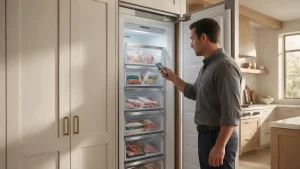
Freezer Repair
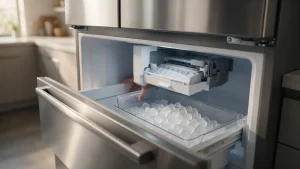
Targeted diagnosis for freezer repair covering compartment temperatures, airflow, sensors, and IceMaker behavior common in Bay Area installations.

Specialized Liebherr Appliance Repair in San Francisco
Mon–Sat: 8:00 AM – 7:00 PM
NoFrost Refrigeration vary by layout and controls. This page covers the main configurations seen in San Francisco homes and the symptoms that usually point to airflow, sensing, or door conditions.
NoFrost is Liebherr’s term for freezers and freezer sections that do not build up ice on their walls, because the compartment is cooled by circulated air and the frost that forms on a hidden evaporator is cleared automatically. This page describes the principle, the parts involved, and the symptoms that suggest the chain has been interrupted.
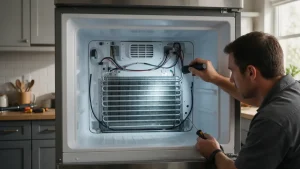
A fan draws air across a cold evaporator and pushes it into the freezer. Moisture in that air freezes onto the evaporator rather than onto the food. At intervals a heater warms the evaporator slightly to melt that frost, and the water runs out through a drain. The compartment then returns to deep-freeze temperature.
In a conventional freezer, the cold plate is inside the compartment, and frost collects on the walls and must be removed by hand. NoFrost removes that chore, but it adds a fan, a heater, and a drain to the list of parts that have to work together.
A thick layer of frost on the rear wall, ice at the base of the freezer, or water around the cabinet after a defrost all suggest an interrupted step. Ice in the drawers alone can reflect humid air getting in through a door that does not seal. The location of the frost is as informative as its thickness.
The rating plate is commonly on the interior wall or at the edge of the top drawer cavity. The service number is needed to identify which control and defrost arrangement the freezer uses.
Clear the vents, check the seal, read the temperature, and note where the frost is heaviest. If the freezer is manually defrosted, use towels, not tools. Never chip ice or remove the rear panel.
The NoFrost service page explains the visit. The models section includes NoFrost freezers such as the GN series, and the error-code pages describe tokens that appear on supported controllers.
Coastal air is moist, and each opening of the door carries that moisture inside. A NoFrost freezer handles it well in normal use, but a seal that is slightly worn, or a door opened often during a party, can increase the frost load considerably. Keeping openings short is the easiest remedy.
Pack items so air can move around them, wrap or cover food to limit moisture, and avoid placing warm items directly against the rear wall. Because the system removes frost on its own, any visible build-up deserves attention rather than being accepted as a normal part of use.
If frost has been cleared by hand, restart the freezer with the door closed and allow several hours to reach temperature before refilling. Keep a note of the date, and watch how quickly frost returns, since that interval is informative to a technician.
Describe where the frost is, how thick it is, how long since it was last cleared, and whether the freezer temperature has changed. Mention if the fan can be heard when the door is opened, and whether water has appeared around the cabinet. Those observations map directly onto the stages of the cycle.
A little frost on the packaging of food that has been in the freezer a long time is normal, as is a short rise in temperature during a defrost cycle. A film of ice on the walls themselves is not part of the design. Knowing this difference prevents both needless worry and the habit of ignoring a real fault because frost seemed expected.
Usually on the rating plate inside the fresh-food compartment or on the door frame. On built-in units open the door fully.
No. Short codes can have different meanings by platform and generation.
BioFresh is a temperature-controlled zone with its own behavior. Problems there are diagnosed separately from the main cabinet.
Targeted diagnosis for freezer repair covering compartment temperatures, airflow, sensors, and IceMaker behavior common in Bay Area installations.
Targeted diagnosis for nofrost system repair covering compartment temperatures, airflow, sensors, and IceMaker behavior common in Bay Area installations.
BT011 points to a condition described in Liebherr documentation for specific platforms. Measured temperatures clarify the impact.
BT021 points to a condition described in Liebherr documentation for specific platforms. Measured temperatures clarify the impact.
BT031 points to a condition described in Liebherr documentation for specific platforms. Measured temperatures clarify the impact.
BT041 points to a condition described in Liebherr documentation for specific platforms. Measured temperatures clarify the impact.
BT071 points to a condition described in Liebherr documentation for specific platforms. Measured temperatures clarify the impact.
Er points to a condition described in Liebherr documentation for specific platforms. Measured temperatures clarify the impact.
Diagnostic notes for the GN 2323 focusing on compartment behavior and model-specific checks.
Diagnostic notes for the GN 3023 focusing on compartment behavior and model-specific checks.
Diagnostic notes for the GN 4135 focusing on compartment behavior and model-specific checks.
Diagnostic notes for the IGN 2556 focusing on compartment behavior and model-specific checks.
Diagnostic notes for the IGN 2566 focusing on compartment behavior and model-specific checks.
Diagnostic notes for the Monolith MF 3051 focusing on compartment behavior and model-specific checks.
Diagnostic notes for the SIFNe 5188 focusing on compartment behavior and model-specific checks.
Reference for biofresh refrigeration covering subtypes, typical symptoms, and where to find the model number in San Francisco installations.
Reference for bottom-freezer refrigerators covering subtypes, typical symptoms, and where to find the model number in San Francisco installations.
Reference for built-in refrigeration covering subtypes, typical symptoms, and where to find the model number in San Francisco installations.
Reference for icemakers covering subtypes, typical symptoms, and where to find the model number in San Francisco installations.
Reference for Liebherr freezers covering subtypes, typical symptoms, and where to find the model number in San Francisco installations.
Reference for Liebherr refrigerators covering subtypes, typical symptoms, and where to find the model number in San Francisco installations.
Reference for monolith refrigeration covering subtypes, typical symptoms, and where to find the model number in San Francisco installations.
Reference for wine cabinets covering subtypes, typical symptoms, and where to find the model number in San Francisco installations.
Share a few details and we’ll confirm an appointment. Prefer to talk? Call us and we’ll help right away.