BioFresh System Repair
Targeted diagnosis for biofresh system repair covering compartment temperatures, airflow, sensors, and IceMaker behavior common in Bay Area installations.

Specialized Liebherr Appliance Repair in San Francisco
Mon–Sat: 8:00 AM – 7:00 PM
BioFresh Refrigeration vary by layout and controls. This page covers the main configurations seen in San Francisco homes and the symptoms that usually point to airflow, sensing, or door conditions.
BioFresh is the name Liebherr gives to its fresh-keeping drawers, which are intended to operate at a lower temperature than the main compartment, close to freezing, and with a choice of dry or humid conditions on many models. This page explains what that means in practice for owners, and why a drawer’s behavior differs from the rest of the cabinet.
The drawers are normally found at the bottom of the fresh-food section, above a freezer drawer or on their own. Some cabinets have one drawer, and others have two or three. The drawers are designed to hold fish, meat, dairy products, fruit, and vegetables for longer periods than ordinary shelves allow.
A slider or a setting on the drawer controls how much air passes through. The dry mode suits meat and fish, and the humid mode suits fruit, salad, and herbs. If the slider is stiff or the mode cannot be changed, moisture behavior will differ from what the drawer is designed to deliver, even if the temperature is correct.
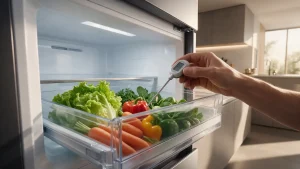
Frozen edges on salad leaves, crystallized surfaces on meat, and drawers that feel no colder than the shelves above are all reported. The first can be an over-cold zone or a load pressed against the back wall. The last can be a seal or airflow problem. A thermometer placed in the drawer, left for several hours, separates these cases.
The plate is usually on the interior wall of the main compartment. For BioFresh specifics, the operating instructions tied to the service number state the intended temperature range for your unit, which is the standard against which readings are compared.
Keep contents away from the rear wall, close the drawer fully, and make sure the lid sits flat. Operate the humidity setting and note whether it moves smoothly. Do not remove the drawer rails or any cover behind them.
The BioFresh service page describes what a visit involves. The error-code pages list tokens that relate to compartment sensors on supported platforms, and models with BioFresh drawers include several in the model section.
San Francisco households tend to buy fresh produce and fish frequently and store it for days. A drawer that freezes or fails to chill is therefore noticed quickly, and early measurement helps separate a loading habit from a real fault. Note what was stored and how long it took to change.
Wrap strongly scented items, keep produce dry before storing, and allow warm food to cool before it goes into the drawer. Rotate stock so older items sit at the front. These practices help the drawer do its job and reduce the condensation that can make a healthy drawer appear to have a problem.
Sometimes food spoils early even though the thermometer reads correctly. In that case, humidity setting, packaging, and the length of storage are the most likely factors. If food continues to freeze or spoil with correct readings and sensible loading, record the details for the technician.
Say which drawer, what food, how it was packaged, and which humidity setting was used. Add the drawer reading and the main compartment reading, taken at the same time, with the set point shown on the display. Those four pieces of information usually let a technician judge whether the issue is loading, setting, or hardware.
Usually on the rating plate inside the fresh-food compartment or on the door frame. On built-in units open the door fully.
No. Short codes can have different meanings by platform and generation.
BioFresh is a temperature-controlled zone with its own behavior. Problems there are diagnosed separately from the main cabinet.
Targeted diagnosis for biofresh system repair covering compartment temperatures, airflow, sensors, and IceMaker behavior common in Bay Area installations.
Targeted diagnosis for bottom-freezer refrigerator repair covering compartment temperatures, airflow, sensors, and IceMaker behavior common in Bay Area installations.
Targeted diagnosis for built-in refrigeration repair covering compartment temperatures, airflow, sensors, and IceMaker behavior common in Bay Area installations.
Targeted diagnosis for monolith refrigeration repair covering compartment temperatures, airflow, sensors, and IceMaker behavior common in Bay Area installations.
Targeted diagnosis for refrigerator repair covering compartment temperatures, airflow, sensors, and IceMaker behavior common in Bay Area installations.
AFr points to a condition described in Liebherr documentation for specific platforms. Measured temperatures clarify the impact.
BT001 points to a condition described in Liebherr documentation for specific platforms. Measured temperatures clarify the impact.
btE points to a condition described in Liebherr documentation for specific platforms. Measured temperatures clarify the impact.
btP points to a condition described in Liebherr documentation for specific platforms. Measured temperatures clarify the impact.
dOr points to a condition described in Liebherr documentation for specific platforms. Measured temperatures clarify the impact.
E0 points to a condition described in Liebherr documentation for specific platforms. Measured temperatures clarify the impact.
Diagnostic notes for the CBN 5413 focusing on compartment behavior and model-specific checks.
Diagnostic notes for the CBNes 5168 focusing on compartment behavior and model-specific checks.
Diagnostic notes for the CS 2062 focusing on compartment behavior and model-specific checks.
Diagnostic notes for the HC 1540 focusing on compartment behavior and model-specific checks.
Diagnostic notes for the HC 1541 focusing on compartment behavior and model-specific checks.
Diagnostic notes for the HCB 1560 focusing on compartment behavior and model-specific checks.
Diagnostic notes for the HCB 2080 focusing on compartment behavior and model-specific checks.
Diagnostic notes for the ICBN 3366 focusing on compartment behavior and model-specific checks.
Diagnostic notes for the ICBN 3386 focusing on compartment behavior and model-specific checks.
Diagnostic notes for the Monolith MRB 3600 focusing on compartment behavior and model-specific checks.
Diagnostic notes for the SBS 246 focusing on compartment behavior and model-specific checks.
Diagnostic notes for the SBSes 7155 focusing on compartment behavior and model-specific checks.
Reference for bottom-freezer refrigerators covering subtypes, typical symptoms, and where to find the model number in San Francisco installations.
Reference for built-in refrigeration covering subtypes, typical symptoms, and where to find the model number in San Francisco installations.
Reference for icemakers covering subtypes, typical symptoms, and where to find the model number in San Francisco installations.
Reference for Liebherr freezers covering subtypes, typical symptoms, and where to find the model number in San Francisco installations.
Reference for Liebherr refrigerators covering subtypes, typical symptoms, and where to find the model number in San Francisco installations.
Reference for monolith refrigeration covering subtypes, typical symptoms, and where to find the model number in San Francisco installations.
Reference for nofrost refrigeration covering subtypes, typical symptoms, and where to find the model number in San Francisco installations.
Reference for wine cabinets covering subtypes, typical symptoms, and where to find the model number in San Francisco installations.
Share a few details and we’ll confirm an appointment. Prefer to talk? Call us and we’ll help right away.