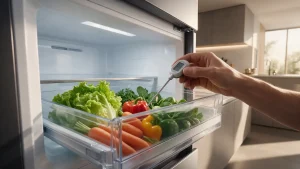
BioFresh System Repair
Targeted diagnosis for biofresh system repair covering compartment temperatures, airflow, sensors, and IceMaker behavior common in Bay Area installations.

Specialized Liebherr Appliance Repair in San Francisco
Mon–Sat: 8:00 AM – 7:00 PM
Bottom-Freezer Refrigerators vary by layout and controls. This page covers the main configurations seen in San Francisco homes and the symptoms that usually point to airflow, sensing, or door conditions.
Bottom-freezer refrigerators from Liebherr put the fresh-food compartment at eye level and the freezer in one or more drawers below. The layout is popular in compact kitchens because the food used most often sits where it is easiest to reach, and the less-used frozen goods sit lower.
The upper section opens like any refrigerator door, while the freezer drawer pulls out on runners. Cold air is produced in the lower part of the cabinet and shared with the upper section through internal ducts. This arrangement means the two compartments are linked, and a problem in the lower one can quickly be felt in the upper one.
A freezer drawer has to close squarely and seal on all four sides. Its gasket compresses against the cabinet frame, and a basket that sits slightly crooked or a box that overhangs the front can break that seal. The drawer front is also the place where humid room air first meets the cold, so frost often appears there before anywhere else.
Owners describe frost along the drawer gasket, a drawer that no longer glides, or an upper section that is cooler on one side. Frozen food that softens only at the front of the drawer suggests a seal problem rather than a failure of the cooling system itself.
The label for these cabinets is commonly found on the upper interior wall or beside the upper door frame, and sometimes at the top of the freezer cavity once the drawer is pulled out. Record the full model and service number before contacting anyone.
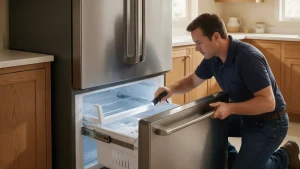
Pull the drawer out and look at its gasket and runners for dirt or damage. Make sure that the basket is seated and that the front edge of the contents is clear. Read the freezer with a separate thermometer. Do not detach the drawer front or remove the base grille to look inside.
The service page for this layout explains how a visit works. The error-code pages explain tokens as documented for each platform, and the model pages cover bottom-freezer cabinets such as the HC series named in the models section.
Because bottom-freezer units are space-efficient, they are common in smaller San Francisco flats. A cabinet fitted snugly beside a wall needs enough clearance for the door to open fully and the drawer to slide out. Floors that slope slightly in older buildings can cause the door to swing on its own, so levelling the feet is a recommended step after installation.
Pull the drawer out smoothly rather than tugging at it, and push it fully home each time. Avoid letting items hang over the back or sides, where they can catch on the frame. Sorting frozen goods into shallow trays keeps the basket light, which helps the runners last and keeps the front edge tidy for a clean seal.
Most models in this format are designed to minimize frost, but a small amount around the gasket is common in humid weather. Wipe it away with a soft cloth when the drawer is warm to the touch, and avoid scraping. Persistent frost returning within days is worth recording with its location.
Useful details include which section is affected, whether the drawer slides without effort, where frost first appears, and whether the problem began after a power cut, a move, or a heavy shopping trip. Add the freezer reading and the refrigerator reading taken at the same time, since the relationship between the two is often the key clue.
If the drawer gasket is visibly torn or the drawer cannot be closed, say so first, because that alone may explain the symptoms.
Usually on the rating plate inside the fresh-food compartment or on the door frame. On built-in units open the door fully.
No. Short codes can have different meanings by platform and generation.
BioFresh is a temperature-controlled zone with its own behavior. Problems there are diagnosed separately from the main cabinet.
Targeted diagnosis for biofresh system repair covering compartment temperatures, airflow, sensors, and IceMaker behavior common in Bay Area installations.
Targeted diagnosis for bottom-freezer refrigerator repair covering compartment temperatures, airflow, sensors, and IceMaker behavior common in Bay Area installations.
Targeted diagnosis for built-in refrigeration repair covering compartment temperatures, airflow, sensors, and IceMaker behavior common in Bay Area installations.
Targeted diagnosis for monolith refrigeration repair covering compartment temperatures, airflow, sensors, and IceMaker behavior common in Bay Area installations.
Targeted diagnosis for refrigerator repair covering compartment temperatures, airflow, sensors, and IceMaker behavior common in Bay Area installations.
AFr points to a condition described in Liebherr documentation for specific platforms. Measured temperatures clarify the impact.
BT001 points to a condition described in Liebherr documentation for specific platforms. Measured temperatures clarify the impact.
btE points to a condition described in Liebherr documentation for specific platforms. Measured temperatures clarify the impact.
btP points to a condition described in Liebherr documentation for specific platforms. Measured temperatures clarify the impact.
dOr points to a condition described in Liebherr documentation for specific platforms. Measured temperatures clarify the impact.
E0 points to a condition described in Liebherr documentation for specific platforms. Measured temperatures clarify the impact.
Diagnostic notes for the CBN 5413 focusing on compartment behavior and model-specific checks.
Diagnostic notes for the CBNes 5168 focusing on compartment behavior and model-specific checks.
Diagnostic notes for the CS 2062 focusing on compartment behavior and model-specific checks.
Diagnostic notes for the HC 1540 focusing on compartment behavior and model-specific checks.
Diagnostic notes for the HC 1541 focusing on compartment behavior and model-specific checks.
Diagnostic notes for the HCB 1560 focusing on compartment behavior and model-specific checks.
Diagnostic notes for the HCB 2080 focusing on compartment behavior and model-specific checks.
Diagnostic notes for the ICBN 3366 focusing on compartment behavior and model-specific checks.
Diagnostic notes for the ICBN 3386 focusing on compartment behavior and model-specific checks.
Diagnostic notes for the Monolith MRB 3600 focusing on compartment behavior and model-specific checks.
Diagnostic notes for the SBS 246 focusing on compartment behavior and model-specific checks.
Diagnostic notes for the SBSes 7155 focusing on compartment behavior and model-specific checks.
Reference for biofresh refrigeration covering subtypes, typical symptoms, and where to find the model number in San Francisco installations.
Reference for built-in refrigeration covering subtypes, typical symptoms, and where to find the model number in San Francisco installations.
Reference for icemakers covering subtypes, typical symptoms, and where to find the model number in San Francisco installations.
Reference for Liebherr freezers covering subtypes, typical symptoms, and where to find the model number in San Francisco installations.
Reference for Liebherr refrigerators covering subtypes, typical symptoms, and where to find the model number in San Francisco installations.
Reference for monolith refrigeration covering subtypes, typical symptoms, and where to find the model number in San Francisco installations.
Reference for nofrost refrigeration covering subtypes, typical symptoms, and where to find the model number in San Francisco installations.
Reference for wine cabinets covering subtypes, typical symptoms, and where to find the model number in San Francisco installations.
Share a few details and we’ll confirm an appointment. Prefer to talk? Call us and we’ll help right away.