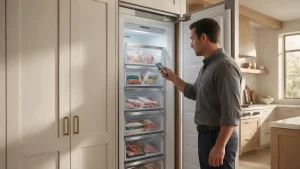
Freezers
Reference for Liebherr freezers covering subtypes, typical symptoms, and where to find the model number in San Francisco installations.

Specialized Liebherr Appliance Repair in San Francisco
Mon–Sat: 8:00 AM – 7:00 PM
San Francisco homeowners dealing with freezer repair get measured diagnosis first. We separate simple seal or setting issues from sensor, airflow, or control problems before any parts are considered.
A freezer that no longer holds a steady deep-freeze temperature puts a lot of food at risk quickly, so freezer repair begins with the question of whether the contents are still safe. Whether the unit is a stand-alone upright or a freezer column, the diagnostic path starts with measurements rather than assumptions.
If the freezer has been warm for hours, check whether items still feel hard and whether any ice crystals have formed on the surface of packages. Food that has partly thawed should not be refrozen blindly. Moving the most valuable items to a cooler with ice, or to a neighbor’s freezer, buys time while the cause is found.
Opening a freezer door briefly lets warm air in, which then contracts as it cools and creates a slight vacuum. Doors that seem stuck after a recent opening usually release after a minute or two. If the door sticks constantly, the gasket may be worn, dirty, or misaligned, which also explains frost near the seal.
A freezer alarm is meant to warn that the compartment has warmed beyond an acceptable limit. It may trigger after a large load of unfrozen food, a long door opening, or a power interruption, and it should clear on its own once the temperature recovers. An alarm that persists after several hours of normal use deserves a closer look.
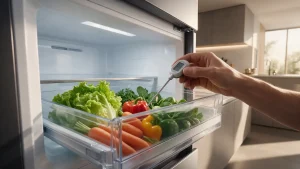
Read the freezer with a separate thermometer after the door has been closed for a few hours. Check that the gasket is clean and seated, that nothing prevents the door from closing, and that the unit is level. Note the display value, the alarm status, and any code. Do not attempt to defrost with sharp tools or hot air.
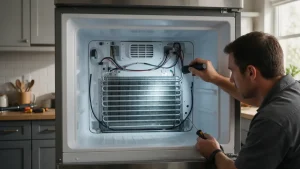
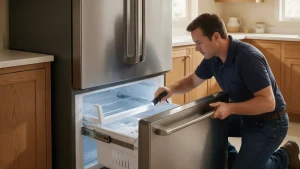
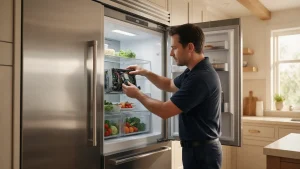
The technician reads the freezer at a stable point, inspects the door and gasket, observes compressor behavior from the outside, and notes whether the pattern fits frost buildup, a sensing problem, or something else. Findings go into a written estimate so you can decide what to do next.
San Francisco’s mild climate fools some owners into placing a freezer in a garage or utility closet. When that space turns cool at night and stuffy in a warm spell, the freezer works in an environment that was never intended. Mentioning where the unit stands helps interpret what the readings mean.
Have the model number, the age of the freezer if known, and any recent power outages or relocations ready to share. No repair proceeds without your approval of the written estimate.
A full, closed freezer holds its temperature longer than a half-empty one, because the frozen mass acts as a thermal reserve. Keeping the door shut during an outage and filling gaps with containers of water frozen solid can extend that time. These steps do not repair anything but they protect the contents while a visit is arranged.
A freezer that is working hard tends to be louder and warmer to the touch on the sides, which is normal when ambient heat is high. A sudden new sound, or a compressor that starts and stops frequently, is worth recording in detail with the time and the temperature at that moment.
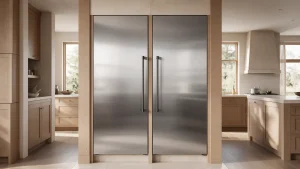
Columns and cabinets differ in how air is moved and where sensors sit. Whichever you own, the rating plate number tells us which design applies, and therefore which checks and readings are meaningful for your particular freezer.
After the freezer has been assessed, the estimate lists what was found, what is recommended, and what the cost covers, in ordinary language. You can ask questions before agreeing, and you can choose to do nothing and keep the findings for later. No work starts until you have said yes.
If the freezer is old enough that repair is unlikely to be worthwhile, that is also explained honestly, with the reasons.
Many codes indicate a sensor or temporary condition. The unit may continue running while the control limits certain functions. Measured temperatures tell whether food safety is affected.
A normal power cycle is safe. Repeated resets without recording the code and temperatures usually do not resolve the underlying condition.
Yes. Platform differences change sensor locations, BioFresh behavior, and code meanings. The rating plate number is the starting point.
Reference for Liebherr freezers covering subtypes, typical symptoms, and where to find the model number in San Francisco installations.
Reference for nofrost refrigeration covering subtypes, typical symptoms, and where to find the model number in San Francisco installations.
BT011 points to a condition described in Liebherr documentation for specific platforms. Measured temperatures clarify the impact.
BT021 points to a condition described in Liebherr documentation for specific platforms. Measured temperatures clarify the impact.
BT031 points to a condition described in Liebherr documentation for specific platforms. Measured temperatures clarify the impact.
BT041 points to a condition described in Liebherr documentation for specific platforms. Measured temperatures clarify the impact.
BT071 points to a condition described in Liebherr documentation for specific platforms. Measured temperatures clarify the impact.
Er points to a condition described in Liebherr documentation for specific platforms. Measured temperatures clarify the impact.
Targeted diagnosis for biofresh system repair covering compartment temperatures, airflow, sensors, and IceMaker behavior common in Bay Area installations.
Targeted diagnosis for bottom-freezer refrigerator repair covering compartment temperatures, airflow, sensors, and IceMaker behavior common in Bay Area installations.
Targeted diagnosis for built-in refrigeration repair covering compartment temperatures, airflow, sensors, and IceMaker behavior common in Bay Area installations.
Targeted diagnosis for icemaker repair covering compartment temperatures, airflow, sensors, and IceMaker behavior common in Bay Area installations.
Targeted diagnosis for monolith refrigeration repair covering compartment temperatures, airflow, sensors, and IceMaker behavior common in Bay Area installations.
Targeted diagnosis for nofrost system repair covering compartment temperatures, airflow, sensors, and IceMaker behavior common in Bay Area installations.
Targeted diagnosis for refrigerator repair covering compartment temperatures, airflow, sensors, and IceMaker behavior common in Bay Area installations.
Targeted diagnosis for wine cabinet repair covering compartment temperatures, airflow, sensors, and IceMaker behavior common in Bay Area installations.
Share a few details and we’ll confirm an appointment. Prefer to talk? Call us and we’ll help right away.