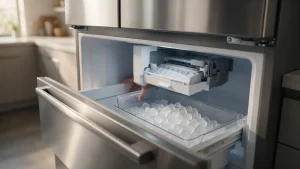
IceMakers
Reference for icemakers covering subtypes, typical symptoms, and where to find the model number in San Francisco installations.

Specialized Liebherr Appliance Repair in San Francisco
Mon–Sat: 8:00 AM – 7:00 PM
San Francisco homeowners dealing with icemaker repair get measured diagnosis first. We separate simple seal or setting issues from sensor, airflow, or control problems before any parts are considered.
Liebherr IceMaker modules produce ice automatically from a water supply, and they combine plumbing, a small mold, an ejection mechanism, and a control that coordinates them. When ice stops arriving, the cause may be as simple as a kinked supply line or as involved as an inlet valve, so the order of checks matters.
Water enters through an inlet valve and fills the mold to a set level. The mold is cooled until the water freezes, and then the ice is released into the bin. The cycle repeats until the bin is full. A fault at any stage shows up differently, from empty molds to oversize or hollow cubes to a slow trickle of ice.
If the fill is weak, cubes come out small and hollow. If it is blocked, the mold stays dry. A kinked line behind the unit, a closed shutoff valve, or a filter that has not been replaced in a long time are the most frequent explanations. Sediment or mineral deposits from household water can gather in small inlets over time.
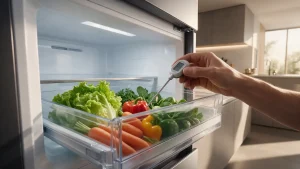
An IceMaker depends on the freezer being cold enough to make ice in a reasonable time. If the freezer itself runs warm, the module may produce nothing at all or very slowly. Measuring the freezer temperature before blaming the IceMaker is one of the first practical steps.
Confirm that the water shutoff is open and the supply line behind the cabinet is not pinched. Check the bin is seated and that the ice is not jammed against the chute. Note the freezer temperature and the last time the water filter was changed. Do not force the ice out with tools, and do not pour hot water into the module.
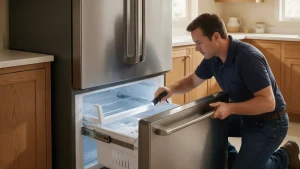
The visit looks at water flow into the mold, the fill level, the cold needed to freeze, and the release of the finished ice. Leaks are traced from the point where water first appears. Where the water inlet is shared with other functions, those are also observed so the diagnosis is complete.
Supply lines in older apartments are sometimes tucked behind panels with limited access, and older shutoff valves may be stiff or partly corroded. A line that was bent during a previous move can slow the fill without being noticed. These practical details are checked early.
Tell us how long the ice has been missing or hollow, the model, and whether the water dispenser is also affected. You will see a written estimate before any repair begins.
A bin that is not seated properly may stop the module from running, since the control senses its position. Cubes that have fused together in the bin can also block the release mechanism. Emptying the bin, drying it, and placing it back correctly are harmless checks that resolve some complaints immediately.
Ice that tastes stale or smells of the freezer is usually the result of old ice sitting too long, or of a filter that has been in service beyond its intended life. Discarding the old ice, replacing the filter according to the manual, and covering strongly scented food in the freezer improve the taste considerably.
Water beneath the module can come from a loose connection, a cracked fitting, or ice that melted and refroze in the wrong place. Dry the area, wait, and observe where moisture first reappears. That location is one of the most useful pieces of information you can give a technician.
After an IceMaker has been assessed, the estimate sets out whether the problem lies in the supply, the module, the freezer temperature, or the release, and what each option would involve. If a simple adjustment such as clearing a kinked line or replacing a filter resolves the issue, that is stated clearly.
You approve the plan in writing before anything is replaced, and the findings stay with you either way.
Many codes indicate a sensor or temporary condition. The unit may continue running while the control limits certain functions. Measured temperatures tell whether food safety is affected.
A normal power cycle is safe. Repeated resets without recording the code and temperatures usually do not resolve the underlying condition.
Yes. Platform differences change sensor locations, BioFresh behavior, and code meanings. The rating plate number is the starting point.
Reference for icemakers covering subtypes, typical symptoms, and where to find the model number in San Francisco installations.
FE points to a condition described in Liebherr documentation for specific platforms. Measured temperatures clarify the impact.
MA001 points to a condition described in Liebherr documentation for specific platforms. Measured temperatures clarify the impact.
WATER points to a condition described in Liebherr documentation for specific platforms. Measured temperatures clarify the impact.
Targeted diagnosis for biofresh system repair covering compartment temperatures, airflow, sensors, and IceMaker behavior common in Bay Area installations.
Targeted diagnosis for bottom-freezer refrigerator repair covering compartment temperatures, airflow, sensors, and IceMaker behavior common in Bay Area installations.
Targeted diagnosis for built-in refrigeration repair covering compartment temperatures, airflow, sensors, and IceMaker behavior common in Bay Area installations.
Targeted diagnosis for freezer repair covering compartment temperatures, airflow, sensors, and IceMaker behavior common in Bay Area installations.
Targeted diagnosis for monolith refrigeration repair covering compartment temperatures, airflow, sensors, and IceMaker behavior common in Bay Area installations.
Targeted diagnosis for nofrost system repair covering compartment temperatures, airflow, sensors, and IceMaker behavior common in Bay Area installations.
Targeted diagnosis for refrigerator repair covering compartment temperatures, airflow, sensors, and IceMaker behavior common in Bay Area installations.
Targeted diagnosis for wine cabinet repair covering compartment temperatures, airflow, sensors, and IceMaker behavior common in Bay Area installations.
Share a few details and we’ll confirm an appointment. Prefer to talk? Call us and we’ll help right away.