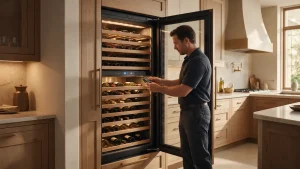
Wine Cabinets
Reference for wine cabinets covering subtypes, typical symptoms, and where to find the model number in San Francisco installations.

Specialized Liebherr Appliance Repair in San Francisco
Mon–Sat: 8:00 AM – 7:00 PM
San Francisco homeowners dealing with wine cabinet repair get measured diagnosis first. We separate simple seal or setting issues from sensor, airflow, or control problems before any parts are considered.
Wine cabinets look simple but they are built around precise, steady temperatures and very little vibration. A Liebherr wine cabinet that drifts a few degrees, hums louder than it used to, or reports a zone that never reaches its set value deserves attention, because bottles age quickly when their temperature wanders.
Many models offer two or more separate zones, for example a cooler one for whites and sparkling wines and a warmer one for reds. Each zone has its own sensor and control, so a drifting zone can be unrelated to its neighbor. Comparing both zones against their set points with a separate thermometer shows which one is out of range.
Wine is sensitive to vibration, so these cabinets are built to run quietly. If the noise changes, check first whether the unit is level, whether it touches a neighboring cabinet, and whether bottles or shelves are rattling against each other. Many apparent mechanical problems turn out to be a loose shelf or a cabinet that is not resting evenly on its feet.
A glass door looks beautiful but is heavier than a solid door and more sensitive to alignment. A gasket that does not seat evenly lets in warm room air, especially in a sunny kitchen. If a door alarm sounds, look for a bottle neck protruding or a shelf that is not fully pushed in.
Confirm that the ventilation space around the cabinet is clear. Note the set point and read the actual temperature at bottle height in each zone. Make sure the door shuts fully and the shelves are seated. Keep the cabinet away from direct sunlight. Do not move bottles unnecessarily, and do not remove covers.
The visit includes zone readings over a period, door and gasket inspection, an assessment of airflow within each zone, and a check of how the unit sits and whether vibration is traveling through the cabinetry. Parts are considered only once these steps are done.
Many local collectors keep a cabinet in a pantry, a living area, or a converted closet with little ventilation. That space can run warm in late summer and cool on foggy nights, forcing the cabinet to work hard. Noting where the unit stands helps explain a drifting reading.
Share the model number, how many zones the cabinet has, and the readings you took. A written estimate comes first, and bottles do not need to be moved unless access requires it.
Cold air must circulate around the bottles. Filling every shelf and pushing bottles to the rear wall restricts that flow and creates warm pockets. Leave a small gap at the back and avoid stacking bottles in front of the vents where the manual describes them.
A wine cabinet fitted next to a dishwasher, a range, or a sunlit window has to fight constant heat from its neighbors. If a zone cannot reach its set point on hot afternoons, but recovers at night, the surroundings are the first thing to consider, not the cooling system.
A tone from a wine cabinet usually relates to a door left open or to a temperature outside the acceptable window. Closing the door firmly and waiting for the temperature to recover will often silence it. If it keeps repeating with a closed door, record the pattern and the display message exactly.
Because wine reacts to long exposure rather than to brief spikes, the record of temperatures over days matters more than a single reading. If you have a data logger or even a simple min/max thermometer, leave it in the cabinet before the visit. The highs and lows it records can reveal swings that a single moment-in-time measurement would miss.
The same principle explains why cabinets that look fine on a short visit can still deserve attention.
Many codes indicate a sensor or temporary condition. The unit may continue running while the control limits certain functions. Measured temperatures tell whether food safety is affected.
A normal power cycle is safe. Repeated resets without recording the code and temperatures usually do not resolve the underlying condition.
Yes. Platform differences change sensor locations, BioFresh behavior, and code meanings. The rating plate number is the starting point.
Reference for wine cabinets covering subtypes, typical symptoms, and where to find the model number in San Francisco installations.
BT012 points to a condition described in Liebherr documentation for specific platforms. Measured temperatures clarify the impact.
BT013 points to a condition described in Liebherr documentation for specific platforms. Measured temperatures clarify the impact.
E1 points to a condition described in Liebherr documentation for specific platforms. Measured temperatures clarify the impact.
E2 points to a condition described in Liebherr documentation for specific platforms. Measured temperatures clarify the impact.
E3 points to a condition described in Liebherr documentation for specific platforms. Measured temperatures clarify the impact.
E7 points to a condition described in Liebherr documentation for specific platforms. Measured temperatures clarify the impact.
Targeted diagnosis for biofresh system repair covering compartment temperatures, airflow, sensors, and IceMaker behavior common in Bay Area installations.
Targeted diagnosis for bottom-freezer refrigerator repair covering compartment temperatures, airflow, sensors, and IceMaker behavior common in Bay Area installations.
Targeted diagnosis for built-in refrigeration repair covering compartment temperatures, airflow, sensors, and IceMaker behavior common in Bay Area installations.
Targeted diagnosis for freezer repair covering compartment temperatures, airflow, sensors, and IceMaker behavior common in Bay Area installations.
Targeted diagnosis for icemaker repair covering compartment temperatures, airflow, sensors, and IceMaker behavior common in Bay Area installations.
Targeted diagnosis for monolith refrigeration repair covering compartment temperatures, airflow, sensors, and IceMaker behavior common in Bay Area installations.
Targeted diagnosis for nofrost system repair covering compartment temperatures, airflow, sensors, and IceMaker behavior common in Bay Area installations.
Targeted diagnosis for refrigerator repair covering compartment temperatures, airflow, sensors, and IceMaker behavior common in Bay Area installations.
Share a few details and we’ll confirm an appointment. Prefer to talk? Call us and we’ll help right away.