

Specialized Liebherr Appliance Repair in San Francisco
Mon–Sat: 8:00 AM – 7:00 PM
A door alarm that keeps repeating usually means something stops the door from sealing, or the door is read as open when it is shut; find what holds it off first.
Checked against model documentation
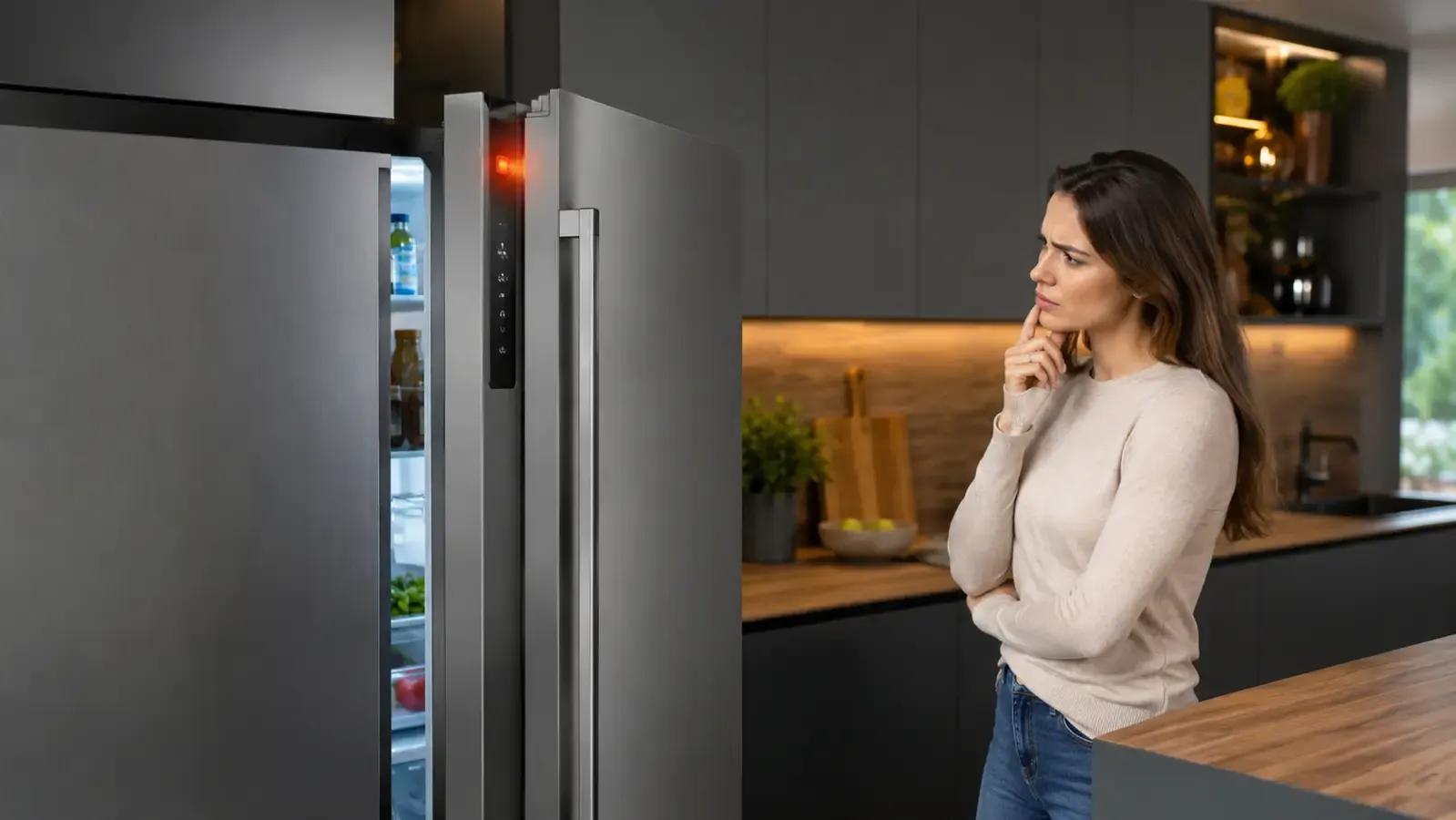
A Liebherr refrigerator door alarm that keeps repeating is nearly always one of two things: something is stopping the door from sealing, or the unit reads the door as open when it is shut. Look for the obstruction before you suspect the electronics, and note how the alarm behaves when you hold the door closed by hand.
Close the door and press it gently against the seal while the alarm is active. If the alarm stops, the door is not sitting where it should, and the cause is mechanical. If it carries on with the door held firmly closed, the unit is not detecting that closure, or is alarming for another reason such as temperature. That one test separates a loading problem from a detection problem and takes half a minute.
It helps to know how the door is built. Liebherr lists the MRB 3610 with four shelves and three door racks, and the door racks on a deep unit hold bottles and jars that stick out toward the cabinet. A tall bottle in a rack, or a shelf pulled forward, can touch the cabinet edge and keep the door a fraction open.
Adjust the load first. On a built-in column the panel on the door can add weight, which is something to mention if you notice the door swinging. Check that nothing in the niche is catching the panel as it opens and closes.
An alarm that sounds with the door closed may be a temperature warning, and the display will say so by flashing the reading or showing a symbol. After a long opening or a power interruption, the interior warms and the unit alarms until it recovers. The message called nA has a stated meaning: Liebherr describes it as the freezer temperature having risen too high in recent hours or days because of a power failure or interruption, and tells you to check the food. See our page on the nA code for how to read it.
If the display shows F0 to F9 or FE, the manual treats it as a fault shown in the temperature display and gives no per-code meaning. It asks you to contact customer service with the code. Do not assume that a door alarm and a code are related unless the technician says so, but report both.
When the sound happens tells you as much as the sound itself. An alarm that starts a short time after every door opening is the reminder working normally, so the question is why the door is staying open. An alarm that arrives in the middle of the night with nobody near the kitchen suggests the door drifted open or the unit lost its closure signal. One that follows a delivery or a clean-up suggests something was left out of place. Keep a note for three days with times and what you had done just before. Patterns like these are easy for a technician to read and hard to reconstruct from memory.
Clearing the obstruction fixes the common case. It cannot reveal whether a door switch or sensor has stuck, whether a gasket has deformed along part of its length, or whether the hinge has shifted. A door that shuts but bounces back, or an alarm that starts only at night, suggests a detection or hinge problem and needs measurement.
Do not silence the alarm for good, loosen hinge screws, or push on a door that resists. A door that has dropped slightly on its hinge can damage its seal further each time it is forced.
A technician looks at the door alignment and the hinge, tests the door-position detection while operating the door through its travel, inspects the gasket along its whole run, and confirms the unit holds temperature with the door closed. For built-in units they may check the panel weight and the niche as well. Our Monolith refrigeration repair page lists the columns we service, and the SIFNe 5188 entry covers a freestanding unit.
Before the visit, collect the model and serial number from the rating label, a note of when the alarm sounds, whether holding the door stops it, and any code you saw.
Either the door is not fully seated, the unit is not detecting the closure, or a temperature warning is sounding. The hold-the-door test narrows it down.
It can if the weight lets the door settle open. We do not hold a weight limit for these units, so mention the panel when you book.
Usually not. Most alarms trace to loading or seating, though a repeating alarm with a closed door is worth a visit.
Share a few details and we’ll confirm an appointment. Prefer to talk? Call us and we’ll help right away.